
Decommissioning: The last stage in the life of a nuclear power plant
The term “decommissioning” encompasses all measures involved in the dismantling of a nuclear installation until it can be released from supervision under nuclear and radiation protection law: starting with fuel removal through the dismantling of components and to the dismantling of building structures. The objective of decommissioning is to ensure that the site can again be used without any restrictions. This may mean that, in a figurative sense, a “greenfield” remains, but it can also mean that parts of the building remain in place and are repurposed.
The Niederaichbach nuclear power plant, the Kahl experimental nuclear power plant and the superheated steam reactor in Großwelzheim are among the facilities in Germany that have already been completely dismantled. Their decommissioning is thus complete. From a technical perspective, other facilities are nearing the end of their decommissioning process or are in various stages of decommissioning. In addition, 31 research reactors have been completely dismantled to date.
Transitional phase: Post-operation
When power operation of a nuclear power plant is permanently discontinued and no decommissioning and dismantling licence has been issued at that time, the plant enters what is known as the post‑operational phase. During this period, certain preparatory measures covered by the operating licence may be carried out for the later dismantling, such as the decontamination of the primary circuit or the removal of the fuel elements from the reactor core.
For most of the recently shut down German nuclear power plants, the first decommissioning and dismantling licence had already been issued before their respective shutdown dates. Accordingly, these plants did not have to enter the post‑operational phase but could instead begin dismantling work directly.
Dismantling can begin
Before a nuclear power plant can be decommissioned and dismantled, the operator must apply to the nuclear regulatory authority for approval. The operator must prove that the plant will be dismantled safely and in compliance with all applicable regulations for the protection of people and the environment.
When the decommissioning and first dismantling licence is utilised, the actual dismantling of the plant begins. Measurements are carried out in all areas of the plant and samples are taken to create a detailed overview of the nuclear power plant’s radioactive inventory.
There are different approaches to dismantling. In the past, those parts of the nuclear power plant that were not or hardly contaminated were dismantled first. Nowadays, the more contaminated or activated parts are dismantled at the beginning, partly by remote control, in order to reduce the activity inventory of the plant and thus the hazard potential as quickly as possible.

1. Decontamination
Contaminated objects and rooms must be decontaminated using special cleaning procedures such as sandblasting or ultrasonic cleaning, which means they must be freed from adhering radioactive particles. The removed radioactive material is collected and prepared for disposal.
2. Remote-controlled disassembly of activated components
Some plant components of the nuclear power plant – such as the reactor pressure vessel – have themselves been activated by neutron radiation during reactor operation, which means that they have become radioactive. For example, the stable cobalt-59 contained in the steel of the reactor pressure vessel is transformed into the radioactive cobalt-60 by neutron capture. This cannot be eliminated by decontamination. Since the dismantling of certain plant components would lead to high radiation exposure for the personnel, these components have to be disassembled into manageable parts by remote control and, if necessary, under water.
3. Decay storage of large components
Some activated plant components are temporarily stored after their dismantling to allow the radiation to decay. For example, at the Lubmin site, steam generators are stored in the former turbine building. After this decay storage period, these components can be further processed using simpler aids and with less radiation protection effort.
Whether decay storage is considered for certain components depends on the specific assessments within the decommissioning project, such as the scheduling as well as the available space for storage.
4. Demolition
The dismantling of a nuclear power plant is currently carried out in most cases from the inside out. In this approach, highly contaminated components, such as the reactor pressure vessel, are removed first. Whether all buildings are actually demolished during decommissioning or whether individual structures are retained for subsequent reuse depends on the specific case. The decommissioning of a power reactor until its release from supervision under nuclear and radiation protection law generally takes between 15 and 20 years.
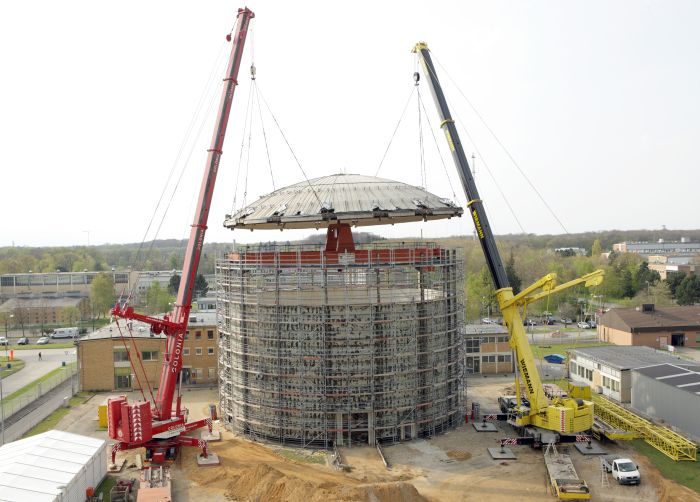
An example: The Obrigheim nuclear power plant
The Obrigheim nuclear power plant, built in the 1960s in Baden-Württemberg on the River Neckar, was finally shut down in 2005. The first application for decommissioning and dismantling of the pressurised water reactor had already been submitted a year earlier. At the end of the summer of 2008, the authorities granted permission for this; the first dismantling work could begin. Plant components from the turbine building, such as turbines, generator, condenser, pumps, valves and water separator-reheaters, could be dismantled.
The application for the second phase of dismantling was submitted in 2008 and approved in 2011. It included the dismantling of plant components in the reactor building, including steam generators, reactor coolant pumps and reactor coolant lines.
The operator applied for the subsequent third dismantling phase in 2010. With the licence granted in 2013, the core of the plant – that is the core structure, the reactor pressure vessel and subsequently the so‑called biological shield – could be dismantled. In August 2015, the reactor pressure vessel, weighing approximately 135 tonnes, was transported to the dismantling area set up in the fuel pool inside the reactor building. There, it was dismantled well shielded under eight meters of water and remotely operated by band saw and plasma cutter.
The application for the fourth dismantling phase, which is still ongoing, was submitted in 2015 and approved in 2018. This licence covers the dismantling of the remaining systems and plant components, such as the ventilation systems, freight lifts and the crane system in the reactor building.
Decommissioning is expected to be completed to the extent that the plant can be released from supervision under nuclear and radiation protection law in the early 2030s.
The challenge of occupational radiation protection: What are the precautions to protect personnel from radiation?
One challenge in decommissioning nuclear power plants is to protect the skilled workers involved from the possible effects of ionising radiation. Depending on the area in which the work arises, the workers wear protective equipment. Particularly strict radiation protection regulations apply to the controlled area of a nuclear power plant – regardless of whether it is in operation or shut down. Here, all workers must wear a dosimeter that measures radiation exposure. Authorities evaluate the dosimeters and check whether the legal limits are being observed.
The challenge of radioactive waste: What happens to the waste generated during decommissioning?
The total dismantling mass of a typical pressurised water reactor (non‑nuclear systems, building structures and the controlled area) is in the range of several hundred thousand tons. For the Isar 2 plant, for example, around 780,000 tonnes are reported. In most cases, more than 90 percent of this material consists of building structures and non‑nuclear systems that show no contamination and can therefore be recycled or conventionally disposed of.
If the material comes from the controlled area, it can be transferred to the recycling process only after control measurements and subsequent clearance by the authority. Only one to two percent of the residual material from decommissioning are radioactively contaminated and must be stored in a storage facility or disposed of in a repository for radioactive waste.
Financial challenge: Who bears the costs of decommissioning?
The costs of dismantling a nuclear power plant vary depending on the type of plant, the strategy and the duration of dismantling. According to rough estimates, up to one billion euros may be incurred per plant. The power utilities (EVU) pay for this amount. The responsibility for storage and disposal rests with the state. The utilities have paid around 24 billion euros into a public fund for this purpose.
Decommissioning abroad: Knowledge transfer as an international task
According to the International Atomic Energy Agency (IAEA), more than 200 power reactors and nearly 60 research reactors worldwide have so far been permanently shut down. By the year 2050, the IAEA expects that around 200 additional reactors will begin the decommissioning process.
However, not all countries have a wealth of knowledge and experience in decommissioning. For this reason, various international projects are working on making knowledge about decommissioning available to authorities, ministries and research organisations.
The international working groups help to answer open research questions and form a communication platform for the exchange of experience for countries that will have to deal with the decommissioning of nuclear installations in the future and will then be faced with questions that other countries have already answered.
Is there still a need for research in the field of decommissioning?
The Federal Ministry of Research, Technology and Space (BMFTR) has been funding research on nuclear decommissioning since the 1980s. Since 2017, around eight million euros have been budgeted annually for this purpose. Research and innovations are intended to make dismantling and the management of radioactive waste as safe, efficient and resource-conserving as possible and to support the training of highly qualified specialists.
The decommissioning of nuclear installations is no longer new scientific territory per se, but there is nevertheless considerable potential for innovations to increase the efficiency of the processes and methods used and to minimise radioactive waste quantities, for example with a view to greater automation (e.g. through robotics) and digitalisation.
On behalf of the BMBF, the GRS project management agency implements the research programme for the decommissioning of nuclear installations (FORKA) and provides project support for the decommissioning and dismantling of experimental nuclear installations. The GRS project management agency supports the Ministry in controlling as well as in the scientific-technical monitoring of the extensive decommissioning and waste management projects financed by the Ministry.
For example, a team of GRS researchers worked on the radiological characterisation of concrete and reactor graphite within the framework of a FORKA project in cooperation with the University of Cologne to determine a suitable waste management option.
In addition, the departmental research of the Federal Ministry for the Environment, Climate Action, Nature Conservation and Nuclear Safety (BMUKN) deals with fundamental and current safety-related problems associated with the decommissioning of nuclear installations.
Researchers at GRS have, for example, investigated on behalf of the Federal Environment Ministry which methods and tools are used in the dismantling of nuclear installations and what future requirements will arise – for instance regarding efficiency or radiation protection. By contrast, the objective of the KISS project (Kompetenz, Innovation, Sicherheit, Strahlenschutz – Competence, Innovation, Safety, Radiation Protection) is to make decommissioning more efficient and safer through the use of modern digital tools.