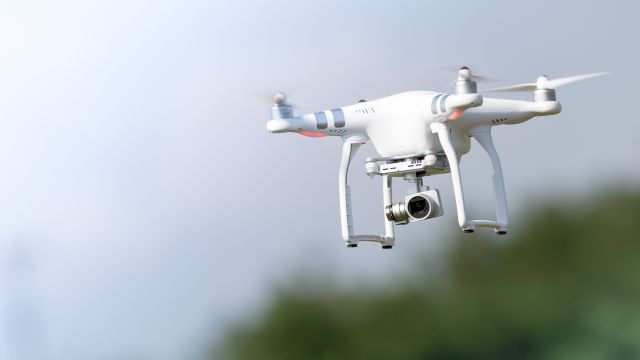
The capabilities of drones: recognising the risks, exploiting their potential
In recent years, drones have evolved from specialised niche systems into versatile tools. They are used in industry and research as well as for security and rescue operations. At the same time, the systems’ range, flight duration, useful load and level of automation are constantly increasing. This is also changing the scope of their potential applications.
Drones in the spotlight of security research
As part of its in-house research project ‘Capabilities of drones and associated risks and applications’, GRS monitors the latest developments in drone technology and assesses their significance for the security of nuclear facilities and for nuclear-specific hazard control. To this end, technical developments, the legal framework and national and international incidents involving drones are systematically analysed.
„The capabilities of drones are evolving very rapidly. In order to assess potential risks to nuclear facilities, we must continuously monitor these developments and evaluate them scientifically.“
Waldemar Stips,Project Manager
Understanding risks and countermeasures
One focus of the project is the analysis of potential threats posed by drones. The project examines the performance parameters of various systems, reported incidents, and methods for detecting and countering drones. Furthermore, the project assesses the technical and legal framework for the use of appropriate countermeasures.
In addition to risks, the experts are also examining the technology’s potential. For example, they are analyzing possible applications of drones in radiation protection, during nuclear emergencies, or to support security operations. For example, they are investigating how drones can be combined with measuring devices or cameras to, for instance, measure radiation levels from the air, survey areas that are difficult to access after an incident, or how drones can be used to conduct automated or even autonomous patrols on company premises.
„In the coming years, drones will become increasingly important for both security tasks and the protection of critical infrastructure. Through our research, we are laying the groundwork for identifying their capabilities and potential risks at an early stage and evaluating them thoroughly.“
Waldemar Stips,Project Manager
Project highlights Physical Protection
Many countries expect Small Modular Reactors (SMRs) to play their part in helping them become less dependent on fossil fuels for electricity generation. However, most SMR concepts are still at different stages of development. While safety aspects already play a role from the first sketches of ideas, security measures (required protection against malicious acts) are often only given a secondary role. Therefore, in a research project that has just started, GRS is dealing with the characteristics of physical protection and computer security of different SMR concepts and to what extent security requirements and concepts of conventional nuclear facilities can be applied to SMRs. In this way, GRS wants to build up expertise and identify open questions in the application of existing rules and regulations.

On 4 August 2020, a devastating explosion occurred in the port of Beirut, the cause of which was the improper storage of chemicals. After Germany had already supported Lebanon in the management of chemicals in the aftermath of this explosion, the Lebanese authorities approached Germany with an additional request for support in the retrieval and safe storage of radioactive waste. Within the framework of a cooperation project funded by the Federal Ministry for the Environment (BMUV), the responsible Lebanese authorities are supported by experts from the BMUV and an interdisciplinary GRS team from the departments Radiation Protection and Security.