Small-scale nuclear power plants: What's behind SMR concepts?
What is an SMR?
According to the current definition, the abbreviation SMR stands for Small Modular Reactor, with ‘small’ usually referring to an electrical output of up to 300 megawatts (MWe). In this context, reactors with an output of approximately 1 to 10 MWe are also referred to as micro-reactors (Micro Modular Reactors, MMR).
The modular character of the plants is reflected in the fact that the key components of a primary circuit – specifically the reactor pressure vessel and the associated cooling circuit – are all to be contained within a single module. The rationale behind this, in addition to transportability, is to use such a module to prefabricate the essential parts of a power plant in a factory, thereby minimising the work required on site. Individual low-power modules should then be able to be combined into a larger power plant as required. Manufacturers hope that standardised series production will reduce manufacturing costs, regulatory risks and construction times in the long run.
In the past, a different definition was commonly used within specialist circles. For instance, the International Atomic Energy Agency (IAEA) used the term ‘Small and Medium-Sized Reactors’ to encompass both small and medium-sized reactors. Reactors with a capacity of up to 300 MWe were classified as ‘small’, whilst those with capacities between 300 and 700 MWe were classified as ‘medium’. Nowadays, however, the first definition of SMR – as small modular reactor – is almost exclusively used. The classification of plants with an electrical output between the upper limit of 300 MWe (according to the newer definition) and conventionally designed nuclear power plants – which the IAEA defines as having an electrical output of approximately 700 MWe and above – is therefore not clear-cut.
What SMR concepts are there right now?
According to the OECD’s Nuclear Energy Agency (NEA), there are currently 127 reactor designs worldwide (as of November 2025) that are classified as SMRs under the current definition. A few of these have already been implemented or are under construction (see section ‘Status of realisation’) whilst the majority are at various stages of design or more concrete planning: According to the OECD/NEA SMR Dashboard, 51 of the 127 SMR designs are in pre-licensing or licensing processes, whilst 25 are not currently being actively pursued.
The vast majority of concepts that are relatively close to being realised or have already been built are so-called light-water reactors – the technology used in the vast majority of conventional nuclear power plants.
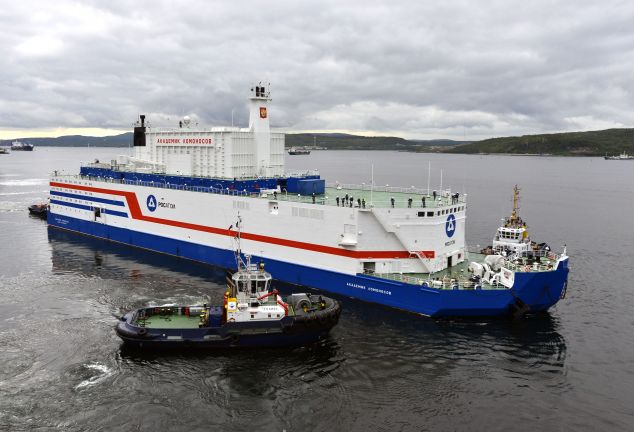
Examples of these SMR concepts include the Akademik Lomonosov floating nuclear power plant, which has been supplying the remote port city of Pevek in Siberia and neighbouring mines with electricity and heat since May 2020, and CAREM (Argentina), which has been under construction since 2014.
Some small light-water reactors, several of which have been in use for decades in icebreakers, submarines or on aircraft carriers, are also sometimes classified as SMRs. However, if we consider electrical output alone, the majority of heavy-water-cooled reactors in India (200 MWe) or the three reactors to be operated at the Russian Bilibino nuclear power plant by the end of 2025 (12 MWe) could also be classified as SMRs; under this definition, the distinction between these and reactors such as the Soviet VVER-440 (440 MWe) or Qinshan-1 (330 MWe) in China would be blurred.
Besides these light-water SMR concepts, however, numerous other concepts are based on reactor technologies that utilise coolants and/or moderators other than water and which, in terms of their reactor physics, differ significantly from light-water reactors in some respects. This is due to a variety of reasons: In some cases, the aim is to achieve safety improvements over light-water reactors through the use of different technologies; in a number of concepts, the intention is to allow - alongside or instead of electricity generation - further applications, such as the extraction of process steam or process heat for industrial uses, the use of transmutation to reduce radioactive waste, the breeding of fuel, or the combustion of weapons-grade fissile material.
Such concepts are sometimes also referred to as Advanced Modular Reactors – essentially meaning ‘advanced’ or ‘novel’ reactors – and are classified as part of the so-called ‘fourth generation’ of reactors. However, a number of SMR concepts classified in this way are based on technologies that were conceived decades ago and, in some cases, were even realised in prototype reactors, without, however, reaching market maturity or becoming widely adopted. Examples of this include high-temperature and breeder reactors, which were also built in Germany, including the THTR-300 at Hamm and the SNR-300 at Kalkar.
In its Advanced Reactor Information System, the IAEA catalogues new reactor concepts, including SMRs, in terms of the coolant and moderator used. However, this classification does not do justice to all the special features of SMRs or new reactor concepts as a whole - developments and characteristics of thorium or high-temperature reactors, for example, are not taken into account. Nevertheless, a subdivision based above all on the coolant is a good idea (see drop-down menu).
- Light-water-moderated and cooled SMR concepts: This type of SMR is certainly the most long-standing and most widespread worldwide. . A differentiation is made here between boiling water reactors and pessurised water reactors.
- Heavy-water-moderated and cooled SMR concepts: So-called heavy water contains the hydrogen isotope deuterium instead of normal hydrogen atoms and therefore absorbs fewer neutrons than normal water. This means that more moderated neutrons are available for nuclear fission. Instead of enriched uranium, natural uranium could therefore also be used as fuel in heavy-water-moderated SMRs. The CANDU-like Indian reactors can be cited as an example here. The use of heavy water in SMRs also potentially allows the utilisation of thorium, from which fissile uranium is then bred during operation.
- Gas-cooled SMR concepts: Gas-cooled SMR concepts rely on the use of gases, such as helium or carbon dioxide, as coolants. Compared to other SMR types, they reach significantly higher coolant temperatures (up to 1,000 degrees Celsius (°C)) and it should therefore be possible to use them to generate process heat in the chemical or petrochemical industry. Low-temperature processes, for example for district heating utilisation, could be connected downstream with these concepts. Two gas-cooled high-temperature reactor modules with a capacity of 250 MWe each have been in operation at the Chinese Shidaowan nuclear power plant since December 2023.
- Liquid-metal-cooled SMR concepts: In SMR concepts with liquid metal cooling, lead, lead-bismuth or sodium should be used as coolants. The metals are characterised by a high boiling temperature and a high thermal capacity. Uranium in combination with plutonium or other transuranium elements will be used as fuel. In order to prevent contaminated primary coolant from reacting with the water-steam cycle, these concepts usually provide for a component cooling system. The core outlet temperatures should be around 750 °C. Steam and heat could then be extracted in a temperature range of 500 to 700 °C for other purposes. A lead-cooled SMR is currently being built in Russia under the name of BREST-300.
- Molten-salt-cooled SMR concepts: Finally, other SMR concepts envisage molten salts both as a coolant and as a fuel carrier. It is assumed that the molten salts tested to date are stable up to temperatures of 1,400 °C. The heat transport properties of molten salts should allow the reactors to be built with significantly smaller dimensions compared to gas-cooled reactors with the same output. The high operating temperatures should allow high efficiencies and heat extraction for industrial high-temperature processes. An experimental thorium-molten salt reactor is currently in operation in China. According to media reports, this is set to be followed by the construction of a commercial 10 MWe reactor by the end of this decade.
Are there any SMRs already in operation or under construction?
The two plants mentioned in the overview above – the HTR-PM (China, in commercial operation since 2023) and the Akademik Lomonosov (Russia, 2020) – are generally cited as SMRs presently in operation according to current understanding. The OECD/NEA lists a third plant in its SMR dashboard: the High Temperature Engineering Test Reactor in Oarai, Japan, around 100 kilometres north of Tokyo. The plant, which has a thermal output of 30 MW, first achieved criticality back in 1998.
In addition, according to the World Nuclear Association, five SMRs are currently under construction:
• the Argentine CAREM-25 (northern part of Buenos Aires Province),
• the Chinese ACP100 (Changjiang site on the island province of Hainan),
• the Russian RITM-200S (‘floating nuclear power plant’ in the Chukotka Autonomous Okrug),
• the Russian BREST-300 (lead-cooled fast breeder reactor in the closed city of Pevek) and;
• the US liquid salt reactor Hermes from Kairos Power (demonstration plant, Oak Ridge, Tennessee).
The OECD/NEA does not list the floating nuclear power plant at Chukotka as ‘under construction’. This discrepancy is likely due to the fact that, whilst the ship and the reactors are already under construction (the RITM-200S reactors are of a type primarily built for the Russian icebreaker fleet and are already in service), no construction work is yet taking place at the site itself. Since, as with the Akademik Lomonosov in Pevek, it is not a conventional nuclear power plant that is being built, ‘only’ the infrastructure needs to be created here to connect the reactors at a later date.
Will SMRs become more widespread?
It is currently difficult to say whether SMRs will be built and commissioned on a significantly larger scale in the future.
In addition to the technical and regulatory challenges, which are particularly prevalent in SMR designs that do not rely on light-water reactor technology, economic considerations currently also tend to speak against the widespread use of SMRs. This is partly due to the fact that the cost of generating the same amount of electricity in a large nuclear power plant is lower than in a smaller plant. Another factor is that the hoped-for cost reductions through mass production could only be achieved with higher production volumes, which in turn would require regulatory standardisation. Insufficient economic viability has recently led, for example, to the termination of a new construction project planned in the US by the manufacturer NuScale at the end of 2023. NUWARD, a subsidiary of the French utility EdF, also scrapped its SMR concept – developed over four years – in spring 2024 following discussions with potential customers, as the generation costs expected by them were unlikely to be achieved with the concept for technical reasons. In early 2025, NUWARD announced that it would finalise a revised concept by mid-2026.
However, it should also be noted that the development and subsequent use of SMRs is receiving strong political and financial support in a number of countries. This applies, on the one hand, to countries such as the USA, Russia and China, which are home to a significant proportion of the companies involved in development and rely heavily on nuclear power for their own electricity supply. In Europe, alongside France, the United Kingdom is particularly noteworthy: Here, the first three SMRs are to be built in Wales and operated by the state-owned company Great British Energy – Nuclear. In a multi-stage tender process, the British manufacturer Rolls-Royce emerged as the ‘preferred bidder’; the British government has already announced the provision of a total of approximately 2.5 billion British pounds (approx. 3 billion euros) for the construction of the first SMR. In some Central and Eastern European countries, such as Poland, Romania and the Czech Republic, plans for using SMRs are also being pushed forward; in some cases, specific sites have already been selected and regulatory reviews have been initiated. Finally, the European Commission has also launched an initiative, the European Industrial Alliance on Small Modular Reactors, which aims to accelerate the development and use of SMRs in Europe.
It should also be borne in mind that, from the perspective of potential users, certain applications of low-carbon power supply by means of SMRs might outweigh the economic disadvantages. For example, in October 2024, announcements by Amazon and Google made headlines when they announced plans to invest in the development and construction of SMRs to ensure a stable and self-sufficient power supply for their data centres that is as climate-friendly as possible. Furthermore, SMRs are to be used for so-called repowering in countries such as the USA and Poland. The aim here is to continue utilising the sites of old coal-fired power plants, along with their grid connections, by replacing them with SMRs of similar capacity. Finally, in countries such as Russia and Canada, the focus is also on supplying remote regions or industrial sites that have no or only an inadequate connection to the national grid.
How safe are SMRs?
As with conventionally designed nuclear power plants, it is difficult to make sweeping judgements about the safety of SMRs – not least because of the sometimes significant technical or design differences that exist between individual SMR concepts. Whilst it is generally possible to assess whether a single design is plausible in terms of its safety-related configuration and complies with recognised principles, it is not possible to make reliable statements about whether a specific plant at a specific site meets all regulatory requirements and can therefore be considered ‘safe’ solely on the basis of design concepts. This requires detailed information, such as the kind that had to be submitted in the few licensing procedures that have been carried out for SMRs to date – for example, regarding the specific technical implementation, the characteristics of safety-relevant components and materials, and site-specific factors such as seismic risks or potential flooding.
Potential advantages over large nuclear power plants
What all SMRs have in common is that, due to their comparatively low output per unit or module, they contain a significantly smaller inventory of nuclear fuel than large nuclear power plants. Consequently, the amount of radioactivity that could be released into the environment in the event of a hypothetical severe accident is also lower. This is not just a question of quantity, but also of the kind of radionuclides involved, which present varying levels of risk. Companies developing SMRs present the comparatively lower risk potential of an individual SMR as a key safety advantage. However, it should be borne in mind that this potential advantage only applies when comparing individual plants.
Furthermore, many designs rely on so-called passive safety systems. For example, there are systems that require neither electrical power nor active intervention by operating personnel to be activated and operated, but instead function through e.g. gravity, natural convection or evaporation. The use of such systems is intended to make it possible, for instance, to cool the reactor even without electrically powered pumps. In certain SMR designs, passive systems are also intended to allow automatic shutdown without the need for an external power supply or human intervention. Such approaches are not entirely new – passive safety features are also used in some conventionally designed nuclear power plants – but are set to play an even greater role in SMRs.
In the case of some novel designs that do not rely on light-water reactor technology, certain accident scenarios are said to be virtually impossible by the laws of nature. For example, studies suggest that a meltdown cannot occur in the Chinese HTR-PM high-temperature reactor.
New safety-related challenges
However, depending on the design, use or location, these potential benefits are also accompanied by new safety-related challenges. For example, in multi-module plants, which combine several reactor modules within a single plant, particular attention must be paid to ensuring that shared systems, such as a central control room, do not increase the risk of so-called common-cause failures. These are situations where several systems could fail simultaneously if they are affected by the same cause, such as a software error or the failure of a technical component. It must also be borne in mind that internal or external hazards – such as plant-internal fires, earthquakes or floods – could affect several modules at the same time.
The planned coupling of SMRs with other applications, such as hydrogen production, heat supply or seawater desalination, also carries the potential for additional risks that must be taken into account during the design and safety assessment. These include possible chemical effects on components, cross-contamination or the risk of explosions following the release of hydrogen. In the case of a connection to a (district) heating network, faults on the part of the heat consumer could also affect safe operation unless appropriate precautions are taken.
Further safety-related issues may arise from the fact that SMRs are also intended to be built in special locations. This applies in particular to the planned use in remote regions in some countries: Here, it should be borne in mind that external emergency services may, under certain circumstances, only arrive significantly later than is the case at conventionally located nuclear power plants, meaning that a higher degree of self-sufficiency may be required. In the case of underground construction, as envisaged for some designs, additional questions arise regarding maintenance, repair and accessibility in the event of incidents or accidents.
Last but not least, some of these innovative concepts raise new safety concerns due to the use of novel materials. For example, in sodium-cooled SMRs it must be ensured that the metallic sodium does not come into contact with oxygen, as it can otherwise ignite easily. The highly corrosive nature of molten salts also places special demands on the choice of materials for safety-relevant components. Although there is already practical experience with this technology – two sodium-cooled reactors are currently in operation in Russia – overall operating experience remains very limited compared to traditional light-water reactors. Many safety improvements in existing (light-water) reactors are based on the analysis of past events; naturally, such empirical data is lacking for most novel SMR concepts.
Furthermore, there is still a need for research into many innovative concepts. This includes the further development and validation of simulation tools for safety assessments as well as experimental studies. In some cases, regulatory requirements also need to be adapted or developed from scratch.
GRS’s work on SMRs
As part of its research and expert activities, GRS addresses a wide range of topics and issues relating to the safety of SMRs. This ranges from the development of methods for so-called probabilistic safety analyses for SMRs and safety assessments of passive systems as intended for use in SMRs and MMRs to analyses concerning the physical protection and IT security of SMR concepts. The (further) development of simulation codes, which are indispensable for safety assessments, also plays a key role in this context. This concerns e.g. extensive adaptations of the GRS-developed AC2 code package, which can be used to simulate the thermohydraulic behaviour in the cooling circuit of a plant in direct interaction with the effects in the containment during operation, disturbances, and incidents and accidents as well as the development of a code for the investigation of SMR reactor cores, some of which differ significantly from those of conventionally designed nuclear power plants.