

Transmutation of radioactive waste: new computational methods for waste management research
The use of nuclear energy generates high-level radioactive waste. This waste contains, among other constituents, actinides such as neptunium, americium and curium as well as several very long-lived fission products. Some of their isotopes decay over very long periods of time and contribute to the long-term radiotoxicity and heat generation of the waste. These properties must be taken into account for storage but, above all, in the planning of a deep geological repository for disposal.
This is why researchers around the world are investigating whether certain long-lived radionuclides can be specifically treated prior to disposal. One possible approach is partitioning and transmutation, or P&T for short. During partitioning, selected long-lived radionuclides are chemically separated. They can then be either fissioned or transformed into other, shorter-lived nuclides through neutron irradiation. This step is referred to as transmutation.
The aim is to modify the nuclide inventory in such a way that long-term radiotoxicity is reduced. Another objective may be to reduce radionuclides with a high migration potential, i.e. radionuclides which, under certain conditions, may be relatively mobile and be transported within the repository environment. This raises the question of whether specific requirements for the long-term safety of a geological repository - and the demonstration of compliance with those requirements - could be met more effectively.
„When assessing partitioning and transmutation, we must consider the entire waste management chain. Converting long-lived radionuclides into shorter-lived ones may offer long-term benefits for geological disposal. At the same time, shorter-lived radionuclides can exhibit higher levels of activity, thereby increasing the requirements for transport and storage. Potential benefits for the long-term safety of a repository must therefore always be assessed together with the impacts on the preceding stages of radioactive waste management.“
Dr. Robert Kilger,Project Manager
Can transmutation replace a deep geological repository? No. Even after transmutation, radioactive materials remain that must be stored safely and ultimately disposed of in a geological repository. In addition, waste is generated by the separation and treatment processes themselves. While P&T can positively influence the properties of certain waste streams, it cannot eliminate the need for geological disposal. The key question is therefore how the overall radionuclide inventory changes and what medium- and long-term implications this has for waste management, including prior extended storage.
Tool developed for detailed analyses
Suitable computational methods are required to quantitatively assess the potential impacts of transmutation on radioactive waste disposal. This was the focus of the TRAMEZI research project, funded by the German Federal Environment Ministry. Rather than evaluating a specific transmutation concept, the project concentrated on the further development of the methods and tools needed to perform such evaluations.
To this end, GRS experts have further developed the in-house MOTIVE computational code. This tool allows detailed calculations of how the composition of radioactive materials changes during neutron irradiation. The resulting nuclide inventories provide in turn a basis for investigating the potential effects of P&T on the transport, storage and disposal of high-level radioactive waste.
For their calculations, the researchers developed numerical models of two concepts: a lead-cooled fast reactor (LFR) and an Accelerator-Driven System (ADS). Within these virtual reactor cores, they placed so-called targets at different positions. In this context, a target refers to a unit containing the materials to be transmuted. The assumed nuclide inventory was based on the composition of a spent fuel assembly from a German nuclear power plant.
Exemplary calculations for a target position
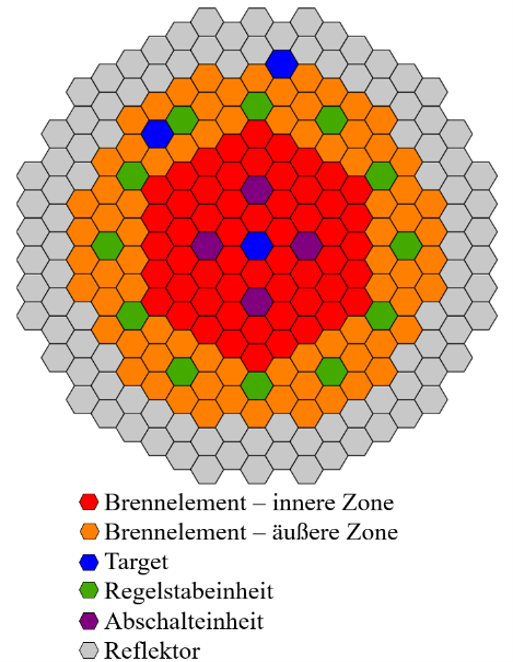
To test the enhancements of MOTIVE, the experts performed exemplary calculations for the two modelled plant concepts. Among other aspects, they investigated how the nuclide inventory changes during the simulated irradiation and how the position of a target within the reactor core influences the transmutation of individual radionuclides.
The calculations showed that the specific position of the target and the local neutron field can significantly influence the transmutation of individual radionuclides. In this study, these investigations primarily served to test and validate the methods developed. Therefore, the transmutation rates determined for individual radionuclides should not be interpreted as quantitatively representative indicators of the overall performance of a particular transmutation concept.
Exemplary results on decay heat
In addition to transmutation rates, the researchers analysed the decay heat of the irradiated targets and the new radionuclides produced within them. Decay heat is generated during radioactive decay and, among other factors, influences the requirements for storage and disposal concepts.
According to the calculations, the additional irradiation of the target initially led to an increase in decay heat. During the first approximately one hundred years, the calculated total decay heat of the investigated target was higher than in the reference scenario of direct disposal of the underlying spent fuel without P&T. This increase was caused, among others, by caesium-137, strontium-90, curium-244, plutonium-238, and americium-241.
For longer time periods, however, a different picture emerged: primarily as a result of the transmutation of americium-241 and plutonium-239, the calculated decay heat was lower than in the reference scenario after approximately one hundred years. For the centrally positioned target, the difference in the integrated gamma activity reached up to 40 percent after around 4000 years.
These results also apply only to the exemplary model configuration examined in the study. They demonstrate that the impact on waste disposal depends on the time period considered.
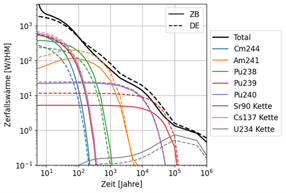
The reduced decay heat after several thousand years represents the desired effect with regard to disposal. At the same time, however, the results indicate an increased heat output up to that point, which in turn has safety-related implications for corresponding longer-term storage.
From method development to application
With TRAMEZI, an enhanced methodological basis is now available for the quantitative analysis of transmutation processes and the resulting nuclide inventories. The exemplary calculations carried out within the project served in particular to develop and test these methods.
In a planned follow-up project, the methods are to be applied to more practice-oriented questions. Among other things, more detailed calculations are planned for lead-cooled fast reactors with more realistic core configurations and loading scenarios. In addition to the targets, the driver fuel will also be taken into account. Together with the respective reactor system, it generates the neutron field required for transmutation and is itself irradiated during operation. This will allow the impacts on transport, interim storage and final disposal to be investigated in greater detail.