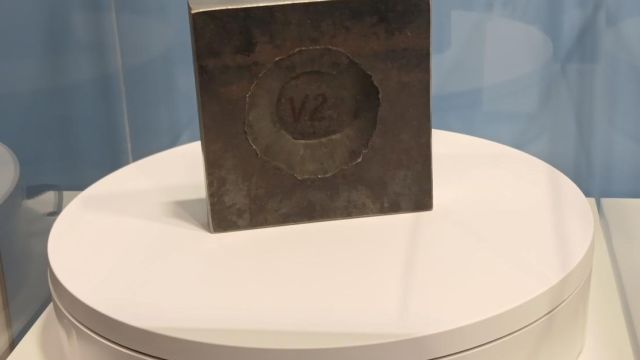
Explosive Impact on Transport and Storage Casks
The protection of nuclear and other radioactive material against malicious acts, including sabotage, is an important element of nuclear security. Explosive devices represent one potential means considered when assessing the structural integrity and protective performance of transport and storage casks.
As part of a comprehensive GRS research programme completed in 2016, experiments investigated the effects of explosive impact on cask structures and potential release processes. Steel plates were used to represent cask walls, with concrete structures behind the plates simulating material inside the cask. Ten small-scale and two large-scale experiments provided valuable experimental data on structural damage, release mechanisms and the assessment of potential consequences of severe explosive loads.
The results contribute to the scientific and technical basis for assessing sabotage scenarios within national nuclear security frameworks and support international efforts under the IAEA Nuclear Security framework. The work was funded by the German Federal Ministry for the Environment.
For decades, GRS has investigated the potential effects of malicious acts and sabotage involving explosives and shaped charges as part of its nuclear security research. The three exhibits illustrate complementary aspects of this work – explosive impact, shaped-charge interaction, and the resulting damage and potential release of material.
GRS continues to advance its research on explosive and shaped-charge impacts in nuclear security. Current and recent work combines experimental data with numerical modelling to better understand penetration, material fragmentation, release and subsequent dispersion, and to further develop and validate methods for assessing complex sabotage scenarios. Recent GRS research reports include:
- (GRS-794) Development of numerical methods for release and dose calculations for highly dynamic sabotage scenarios during the transport of nuclear material | GRS gGmbH
- (GRS-700) Development and exemplary application of probabilistic methods for assessing the potential radiological consequences of release scenarios resulting from sabotage | GRS gGmbH
- (GRS-681) Validation and further development of the modelling of release scenarios involving improvised explosive and incendiary devices (IEDs) using CFD software, with the aim of enabling the methods to be applied to complex scenarios | GRS gGmbH
- (GRS-805) Investigations into the release of radioactive substances from waste containers as a result of explosive impact | GRS gGmbH