

Nuclear energy worldwide 2026
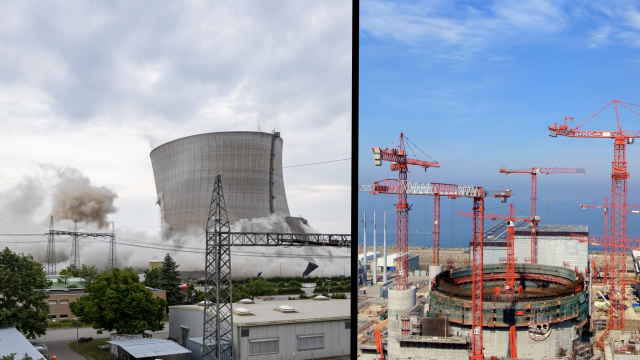
Different approaches are being taken around the world with regard to the utilisation of nuclear energy for power generation. There are three groups that can be roughly distinguished: Some countries are aiming to phase out nuclear energy in the short or medium term, others are extending the lifetimes of NPPs, and still others are planning new builds and in some cases are also focusing on lifetime extensions.
This dossier provides an overview of nuclear energy worldwide. It is updated once a year and published on the GRS website.
Situation worldwide
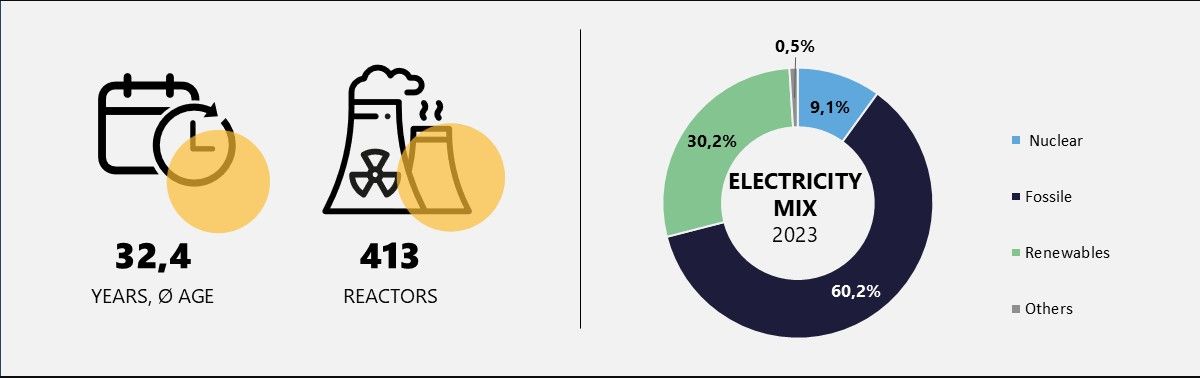
According to the Power Reactor Information System (PRIS) of the International Atomic Energy Agency (IAEA), a total of 413 nuclear reactors are currently in operation worldwide. As reported in the World Nuclear Industry Status Report 2025, they have an average age of around 32 years. In 2025, three new reactor units were connected to the grid – one each in Russia, India and China. On the other hand, seven units were shut down: three in Belgium, three in Russia and one in Taiwan, which thereby completed its nuclear phase‑out.
In addition to the reactors in operation, PRIS also lists 23 other reactors that are in service in ‘suspended operation’ mode. These are reactors that have been shut down for the long term but have not yet been permanently decommissioned. 19 of these plants, also known as ‘long-term outage reactors’, are located in Japan, the remaining four in India.
With regard to the PRIS figures, it should generally be noted that the respective IAEA countries report their data to the database themselves. Any delays that arise as a result can be a reason for deviations from other sources such as the World Nuclear Industry Status Report (WNISR). The figures on the average age of the plants for our overview charts are taken from the WNISR. There, the average age refers to the first day of commercial operation.
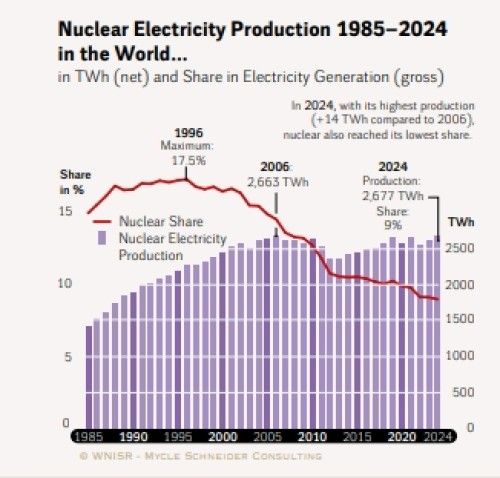
In 2025, worldwide installed nuclear net capacity decreased by 1,066 megawatts to 375,980 megawatts of electricity (MWe) compared to the previous year. While the absolute amount of electricity generated in nuclear power plants has remained largely unchanged in recent decades, its relative share in the global electricity mix fell below the ten per cent mark in 2022 for the first time in around 40 years (the peak value was 17.5 per cent in 1996).
On the one hand, this is due to the fact that more and more electricity is being generated using renewables; on the other hand, electricity generation based on fossil fuels has also increased significantly compared to previous years and decades.
The figures in this text relating to the global electricity mix for the respective continents and to individual countries are taken from the International Energy Agency (IEA) and reflect the status in 2023 and 2024, respectively.
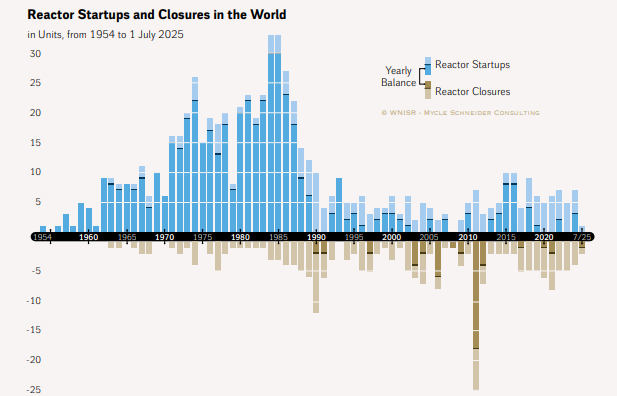
The following trends can be recognised when looking at the constantly changing global reactor landscape: Most new reactor units are being built in Asia, whereas most of the reactors being dismantled are located in Western Europe and North America. Accordingly, the average age of reactors in Asia is comparatively low.
New reactor units also have a higher average output than those that have been decommissioned, meaning that the installed capacity can increase despite a decline in the number of reactor units. The so-called Small Modular Reactors (SMRs) are an exception: These miniature NPPs are expected to play an important role in the medium-term planning of low-carbon, decentralised electricity production in a number of countries.
[Note: Since 2022, the Russian Federation, together with the Central Asian republics, Azerbaijan and Georgia, has been included in the IEA's new Eurasia category. The figures for the European electricity mix therefore do not include the figures for the countries mentioned, which are included for Asia instead. As far as the number of reactors is concerned, we follow the IAEA system, which counts Russia as part of Europe.]
Europe
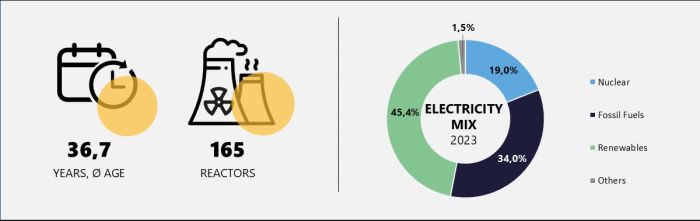
In Europe, nuclear energy accounted for around 18.7 per cent of total electricity generation in 2023. A total of 165 reactors are in operation in Europe, with an average age of 36.7 years. 14 reactors are currently under construction and 132 are being dismantled.
Germany
Germany discontinued using nuclear energy to generate electricity. On 15 April 2023, the last three nuclear power plants, namely Emsland, Isar 2 und Neckarwestheim II, were finally shut down.
But NPPs are not the only nuclear facilities in Germany. Currently, six research reactors as well as the so‑called nuclear supply and waste management facilities continue to operate, such as storage facilities for radioactive waste, the fuel assembly fabrication plant at Lingen and the uranium enrichment plant at Gronau.
Western Europe
France has the world's largest percentage share of nuclear energy in its national electricity mix. In 2024, it was 66.8 per cent. France also has the highest number of reactors in Europe. The average age of French plants is 39.9 years. With Flamanville‑3, the first reactor since 1999 was connected to the grid at the end of 2024. The construction project began in 2007 and was originally scheduled for completion by 2012. However, the schedule was extended several times and the costs have multiplied since then. Nevertheless, nuclear energy is to continue to play an important role in France's climate protection plans: In addition to the expansion of renewables, France's energy plan also provides for an extension of the lifetimes of existing NPPs and the construction of six new EPR-2 reactors at existing sites (Penly, Gravelines and Bugey). According to a current draft law, an additional eight new EPR‑2 units as well as one SMR (NUWARD) are to be built, with the option for six more large reactors.
The United Kingdom also relies on nuclear energy as part of its energy mix – 14.2 per cent of the electricity produced there currently comes from NPPs. Nine reactor units are currently in operation and 36 are being decommissioned. The British government has been pursuing the construction of new NPPs for some time. Two new EPR reactors are under construction (Hinkley Point C‑1 and C‑2), two further EPR reactors are planned for the Sizewell C site – preparatory construction measures were carried out in 2024 – and a Chinese HPR1000 is to be built at the Bradwell site. Building on the “Powering Up Britain” policy paper issued at the end of March 2023, the British government published the “Civil Nuclear Roadmap” in January 2024, which aims to expand nuclear generation capacity to up to 24 gigawatts (GW) and up to eleven new NPPs by 2050. It must be taken into account that the eight AGR units (approx. 4.8 GW) will have to be permanently shut down by the end of this decade due to advanced ageing effects in the graphite moderator. Installed capacity, currently around 6.5 GW, will then decline significantly as the 3.2 GW from the Hinkley Point C new build project are delayed. In addition to constructing large NPPS, the government is also promoting the development and future use of SMRs in the UK. The first SMR is to be built by the state-owned company Great British Energy-Nuclear at the Welsh site of Wylfa. The British manufacturer Rolls‑Royce has been selected as the preferred bidder and the provision of around 3 million euros of government funding has been approved.
In Belgium, two reactors, Doel 4 and Tihange 3, are still in operation, after three reactors were shut down in 2025. The two remaining units are to continue operating until the end of 2035. The country is investing, on the one hand, in research and development work for SMRs and, on the other hand, the Belgian parliament lifted the previous legal ban on new build projects in May 2025. The government aims to extend the operating lifetimes of plants that have already been shut down as well. According to the energy minister in October 2025, the government is holding corresponding talks with the operator. The coalition agreement of the current government also mentions the construction of new plants.
According to the coalition agreement, two new units are to be built by a state‑controlled company in the neighbouring Netherlands in addition to the reactor unit operating in Borssele (which accounts for around 2.9 per cent of the country‘s electricity generation). The government provides 5 billion euros for this purpose. According to government statements from spring 2025, the originally targeted commissioning date of 2035 for the new reactors will be delayed due to setbacks in the site selection procedure. The Borssele NPP is the preferred site for the new reactors, but for legal reasons a potential site near Eemshaven is also to be assessed. The construction of SMRs is also being considered in the Netherlands. Potential sites have been identified within the framework of a study in the province of Gelderland. In addition, the operating life of the Borssele NPP is to be extended beyond 60 years (which would be reached in 2033).
Sweden operates a total of six reactors, which together cover 28.6 per cent of the country's electricity generation. In 2023, the Swedish government adopted a nuclear energy roadmap that provides for the construction of two (by 2033) and a further ten (by 2045) conventional reactors and SMRs. Here, too, the possibility of lifetime extensions is being reviewed (from the current 60 to 80 years).
Alongside France and the United Kingdom, Finland has also been active in recent years in Western Europe regarding the construction of new NPPs: With Olkiluoto-3, the first European Pressurised Reactor (EPR) was connected to the grid in Europe in spring 2023. The average age of Finnish reactors is 38.3 years. Nuclear energy accounts for 39.8 per cent of the electricity mix. The government has extended the operating lifetimes of the two VVER-440 units at the Loviisa site from the previous deadlines of 2027 and 2030 to the end of 2050. Furthermore, by modernising the low-pressure turbines in 2026, the net output of the NPPs is expected to increase.
Alongside Belgium, Switzerland and Spain are currently planning to phase out nuclear energy. The four reactors in Switzerland (which account for 29.2 per cent of the electricity mix) are permitted to continue operation as long as they meet the safety requirements of the regulatory authority. There is a ban on building new nuclear power plants which, however, is currently being discussed. The seven Spanish reactors are scheduled to be gradually taken off the grid by 2035, with the first shutdown planned for 2027 (Almaraz-1). Recently, however, a legislative proposal was introduced aiming to extend the operating lifetimes of the plants. Spain does not have statutory lifetime limits; operating licences are renewed every ten years. After the large-scale power outage at the end of April 2025, these discussions gained momentum. In November 2025, the Spanish energy companies Iberdrola, Endesa and Naturgy applied to extend the operating lifetime of the two units at the Almaraz NPP by around three years until June 2030.
Central and Eastern Europe
In 2023, nine reactors in Ukraine produced 49.4 per cent of the total electricity; the six reactors at the Zaporizhzhia NPP have been shut down since 2022. Despite the war situation and the associated safety-related risk factors, the country will probably continue to rely on nuclear power as its most important form of electricity generation, at least in the medium term. Two largely completed VVER-1000s are to be built at the Khmelnytskyi site (without Russian participation). In addition, two further AP-1000s from Westinghouse are to be built there and at the South Ukraine site to compensate for the loss of the Russian-occupied Zaporizhzhya NPP. A total of nine AP-1000 reactors are planned in Ukraine. Some of the operating reactors have been granted lifetime extensions. The construction of SMRs is also being examined. Among other things, Ukraine has been developing a roadmap and a new law for the introduction of SMRs since October 2025 to create legal and technical foundations for private investments, simplified licensing procedures and the expansion of nuclear energy by 2050.
In Slovakia, Mochovce‑3 became the fifth reactor to enter commercial operation in 2023. The commissioning of another VVER‑440 unit at the site (Mochovce‑4) was expected to follow in 2025 but has been delayed. With this additional reactor, the country is likely to soon compete with France for the highest share of nuclear energy in the electricity mix – in 2024, nuclear power accounted for around 61.9 per cent of Slovakia’s total electricity mix (France: 66.8 per cent).
In 2024, Hungary generated around 42.3 per cent of its electricity from four VVER-440 units at the Paks site. There are plans to build two additional Russian VVER-1200 units there and preparatory work is underway. In addition, according to media reports, at the end of 2025, the Hungarian government agreed in a joint memorandum with the United States to financially support the construction of up to ten SMRs; subsequently, a letter of intent was signed with the US company Holtec providing for the assessment of deploying an SMR-300 in Hungary.
In Slovenia, the only nuclear reactor at the Krško site contributes around 33.5 per cent to the country’s net electricity generation. In January 2023, the operating lifetime of the 44‑year‑old NPP was extended by another 20 years until 2043. Nuclear power is to be expanded in the future to help achieve the country’s CO₂ targets. Depending on electricity demand, the construction of two NPP units is under discussion.
Two AP‑1000 units are also to be built in Bulgaria in addition to the two existing plants; an engineering contract for this was signed in November 2024 with Hyundai Engineering & Construction (South Korea) and Westinghouse (USA). The planned units are intended to supplement the two VVER‑1000 reactors at the Kozloduy site – which currently produce 40.2 per cent of total electricity – for a period of time and then replace them from 2050 onward. In addition, there are letters of intent with U.S. companies regarding the potential deployment of SMRs.
Romania operates two Candu reactors at the Cernavoda site. Two additional Candu units, whose construction began in the 1980s, are scheduled to be completed by 2031. In September 2025, work began on the refurbishment of Cernavoda‑1, which is intended to enable a 30‑year lifetime extension. Romania also plans to build an SMR from the U.S. company NuScale at the site of the former coal-fired power plant in Doicești.
In the Czech Republic, the South Korean company Korea Hydro & Nuclear Power is to build two units of 1,000 MW each at the Dukovany site. Two new units are also planned at the country’s second site, Temelín. At Temelín, the construction of a first SMR is planned by 2032, and two additional SMRs are to be completed at the Dětmarovice and Tušimice sites by 2040. Six pressurised-water reactors currently produce about 40.2 per cent of the Czech Republic’s electricity.
Poland plans to enter the nuclear energy sector, with the first reactor scheduled to go into operation in 2036 according to current plans and five more to follow by 2043. Contracts have been signed with U.S. companies (Westinghouse and Bechtel) for the construction of three AP‑1000 units at the Lubiatowo‑Kopalino site on the Baltic Sea. At the end of 2025, the European Commission approved Poland’s state funding of around 14 billion euros for the first NPP. In parallel, some industrial companies are pursuing plans to build SMRs. For example, a joint venture, involving the energy company Orlen, announced in the summer of 2025 that, in cooperation with GE Hitachi, it intends to build the first of several BWRX‑300 SMRs in Włocławek.
In Belarus, the country’s first reactor unit was commissioned at the Astravets site in 2020, with the second unit starting commercial operation in November 2023. In 2023, nuclear energy accounted for 28.3 per cent of the country’s total electricity generation.
In Armenia, a VVER‑270 at the Metsamor site produces around one quarter to one third of the country’s electricity. Its operating lifetime has been extended until 2036; the reactor is to be shut down only once a replacement is available.
In Russia, 18.7 per cent of total electricity is produced by 34 reactors, whose average age is 29.5 years. Over the last ten years, seven new reactors have been commissioned, including the floating Akademik Lomonosov NPP with two SMRs. Construction has begun on two land‑based SMRs in Siberia. Further units of various types are under construction (for example, the VVER‑TOI in Kursk or the BREST‑300 in Seversk) or in planning. Russia is also very active abroad: In addition to Hungary, Russia is carrying out new builds in Egypt, Iran, India, China, Bangladesh and Turkey.
At the Akkuyu site, an NPP with four Russian VVER‑1200 units is currently under construction. Commissioning is scheduled to take place between 2025 and 2028. In mid‑September 2024, the Turkish Minister of Energy announced that the commercial operation of Unit 1 would be delayed by several months as the German company Siemens Energy was withholding key components. Rosatom therefore ordered the missing parts from China. According to media reports from the summer of 2025, the completion of units 2 to 4 is expected to be delayed due to financing problems. In addition to Akkuyu, several other potential NPP sites in Turkey have been selected, where eight further reactors are to be built in the medium term. In the SMR sector, Turkey is reportedly aiming to build SMR units with a total capacity of up to 5,000 MW.
America
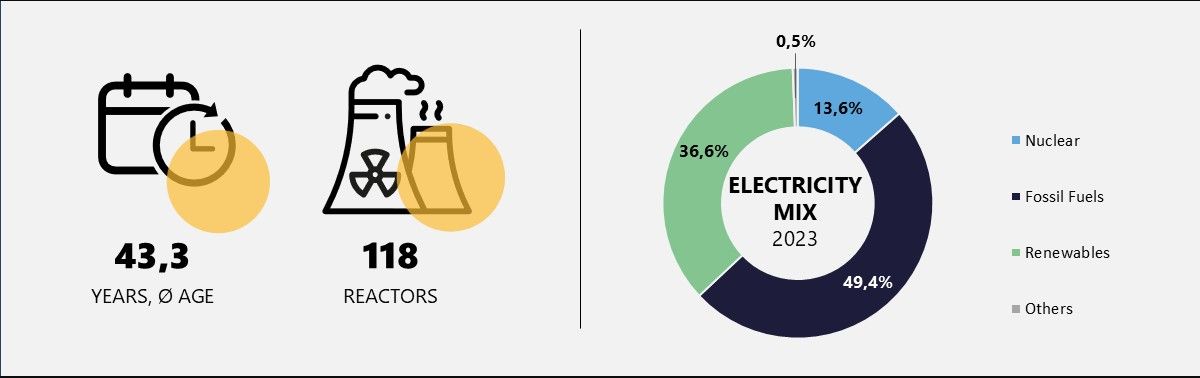
In 2023, nuclear energy accounted for around 13.6 per cent of the total electricity mix on the American continent. There are 118 reactors in operation with an average age of 43.3 years. However, there is a clear north–south divide: While a total of 111 reactors are in operation in the USA and Canada, there are just seven to the south. Two units are currently under construction on the American continent and 49 reactors are permanently shut down – all of them in the United States or Canada.
With 94 reactors, the United States has more on the grid than any other country in the world; in 2024, they provided around 17.8 per cent of the nation’s electricity. The average age of the reactors is 44.2 years. With Vogtle‑3 and Vogtle‑4 commissioned in 2023 and 2024 respectively, the second and third reactors of this millennium (after Watts Bar‑2 in 2016) have been added. The United States is also focusing on lifetime extensions: An extension from 40 to 60 years has already been decided for the majority of reactors, a further extension to 80 years has been approved for more than twenty reactor units and numerous others are currently under review. However, in some cases the retrofitting required for such lifetime extensions would have been too expensive, leading to the shutdown of several plants. The Palisades NPP in the state of Michigan was returned from decommissioning to operating status in August 2025, making it the first U.S. NPP unit to be brought back to the grid after having been shut down. Against the backdrop of the energy and climate crisis, the state of California did not shut down the two units at the Diablo Canyon NPP as originally planned. Instead, the licensee submitted an application for a lifetime extension to the U.S. regulatory authority in November 2023. In its safety report published in June 2025, the authority concluded that the plant could be operated safely for an additional 20 years. There are also plans to restart the Three Mile Island NPP to supply the Microsoft Group with low‑carbon electricity. NextEra Energy is considering similar plans for a possible restart of the Duane Arnold NPP in Iowa. In U.S. energy planning under the Trump administration, nuclear energy is intended to play a larger role. The development of new reactor concepts, especially SMRs, is to be supported. In 2023, however, the first SMR project in the United States with six planned NuScale reactors at a site near Idaho Falls was cancelled due to excessive costs. In addition, U.S. companies are once again increasingly interested in reactor projects (including SMRs) abroad, for example in Bulgaria, Poland, Romania and Ukraine.
In Canada, 17 CANDU reactors supply 13.9 per cent of the national electricity mix. These Canadian developments are heavy‑water reactors with an average age of 41.4 years. The USA’s northern neighbour also relies on lifetime extensions and new build projects, covering SMRs as well as large NPPs. No new large reactor units are currently under construction, but the site for the first commercial SMR has been selected: A BWRX‑300 at the Darlington site is scheduled to go into operation by 2028, and the Canadian regulatory authority issued the construction licence in April 2025. Additional SMRs are planned – some in more, some in less concrete terms.
South of the USA, reactors are operated in only three countries: one CANDU-type reactor and two heavy‑water reactors based on a design by the former German manufacturer KWU in Argentina and two each in Mexico (BWRs by the U.S. manufacturer GE) and Brazil (a 2‑loop Westinghouse reactor and a PWR based on KWU design). In these countries, the share of nuclear energy in the electricity mix ranges between 2.1 and 7.3 per cent. In Argentina, construction of an SMR began in 2015, but after a roughly two‑year interruption starting in November 2019, work has again been halted since September 2024. In addition to this project, a contract for the construction of a Hualong‑1 with a gross output of 1,200‑MW at the Atucha site was signed with China at the beginning of February 2022. There is also a new build plan in Brazil, but the work on a third unit at Angra (based on the Angra‑2 reference plant) has likewise been marked by several long interruptions: After resuming in November 2022, the work has been on hold again since April 2023.
Asia
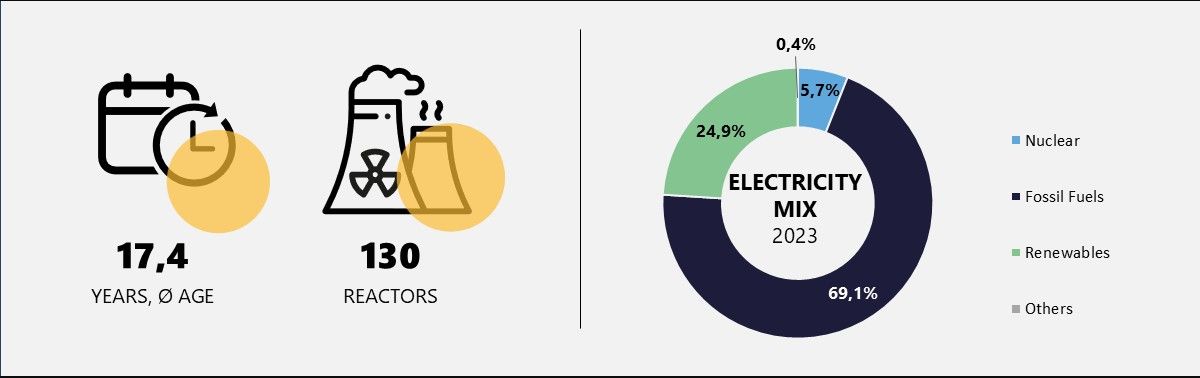
In Asia, nuclear energy accounts for just 5.7 per cent of total electricity production; 130 reactors are operated in eight countries. In addition, there are 23 “suspended operation reactors”, 19 of which are Japanese reactors that have been shut down since the Fukushima reactor accident. The average age of the reactors in operation is 17.4 years. In addition, 43 units are currently under construction – 29 of them in China and six in India. On the other hand, 36 reactors are being dismantled. No other continent is building anywhere near as many new NPPs. It should be borne in mind that Asia accounts for more than 50 per cent of the world’s population and that energy demand has multiplied more rapidly here over recent decades than on any other continent. A correspondingly large number of other (especially fossil-fuelled) power plants have been built, which also explains the relatively low share of nuclear energy in the electricity mix.
Far East
Nuclear energy accounts for 4.5 per cent of China‘s total electricity mix. This share is generated by 61 reactors with an average age of just 11.2 years. One new reactor was commissioned last year and 29 new reactor units of various types are currently under construction (the World Nuclear Association and WNISR mention 38 and 37 new build projects, respectively). In addition to the expansion of renewables, nuclear energy plays an important role in China’s efforts to reduce CO₂ emissions. This is reaffirmed in the current Five‑Year Plan, according to which additional new reactors are planned. The Five‑Year Plan for the period 2026 to 2030 is expected to be published in spring 2026. In addition to conventional power reactors, SMRs also play an important role: Chinese companies are developing a larger number of different SMR designs, including the LingLongOne (ACP100), which is expected to enter operation in 2026, while the world’s first high‑temperature SMR, the HTR‑PM at the Shidaowan site, has already been in operation since late 2023. China is also seeking to enter new markets in order to sell its technology and expertise.
In South Korea, the share of nuclear energy in total electricity production is quite a bit higher with 26 reactors contributing 31.1 per cent of the country’s electricity. The current government has reversed the planned phase-out of nuclear energy. In addition to the expansion of renewables, NPPs are intended to help achieve the country’s climate targets. The share of nuclear energy in the electricity mix is to be increased to 35 per cent by 2036. One reactor was connected to the grid in 2022, another in 2023 and two more are currently under construction. South Korea is also seeking to participate in construction projects in various countries: In the United Arab Emirates, four units built by the Korean manufacturer KHNP have now started commercial operation and two Korean units are to be built at the Dukovany site in the Czech Republic. In addition, talks are underway with countries such as Egypt, Poland, Saudi Arabia and Uganda.
Japan is, of course, among the countries whose energy policy has been strongly influenced by Fukushima. Before the day of the accident, 54 reactors were in operation, contributing almost 30 per cent of the country’s total electricity generation. After the disaster, all of them were initially shut down. 14 of them have since returned to operation. Following the restart of Onagawa‑2 and Shimane‑2 in October and December 2024, Unit 6 of the Kashiwazaki‑Kariwa NPP is scheduled to enter operation in early 2026 after 14 years of inactivity. The first two restart attempts in January 2026 failed due to malfunctions. Several more units are expected to be restarted in the coming years. On the other hand, 27 reactors are currently being dismantled. Nuclear energy currently accounts for 8.4 per cent of the electricity mix, but the current government plans to increase this share to 20 to 22 per cent by 2030. The two reactors under construction are also expected to contribute to this goal. In addition, since mid‑2023, reactors may in principle be operated beyond the previous 60‑year limit. In the long term, next‑generation reactors are to be built to replace old power plants.
In response to the events at Fukushima, Taiwan withdrew from nuclear energy. Beginning in 2018, the six reactors that once produced around half of Taiwan’s electricity were gradually shut down – the last one in May 2025. However, a feasibility study is currently underway to examine whether individual reactors could be brought back into operation. This study was preceded by a change in legislation extending the maximum operating licence from the previous 40 years to up to 60 years.
Middle East
The situation is different in India where a further six units are under construction in addition to the 21 reactors currently in operation. The new builds are India’s own developments based on the CANDU design as well as reactor units of Russian design. There are plans for a large number of additional reactors, including SMRs. These plans were affirmed by the Shanti Act passed in 2025, which, among other things, provides for an expansion of nuclear capacity to 100 GW (up from the current roughly 7.5 GW) by 2047.
Pakistan also uses nuclear energy to generate electricity with six reactor units contributing 17.0 per cent of total electricity generation. One Hualong‑1 unit each was commissioned at the Karachi site in 2021 and 2022, and another unit at the Chashnupp site is currently under construction.
A VVER‑1000 has been operating in Iran for a good twelve years and a second one is under construction. According to Iranian information, another 4‑unit plant is under construction at the Sirik site in the south of the country. However, this appears to involve mainly preparatory work as the IAEA does not list this plant in its Power Reactor Information System. In September 2025, Iran and Russia signed contracts for the construction of the plant.
In Asia, there are also a number of countries that are currently starting nuclear energy programmes. These include Bangladesh, where two Russian‑designed reactor units have been under construction since 2017 and 2018 respectively, and the United Arab Emirates, where four reactors have been commissioned successively since 2020, the last of them in March 2024. Uzbekistan and Kazakhstan also have relatively concrete plans to start using nuclear energy.
Africa
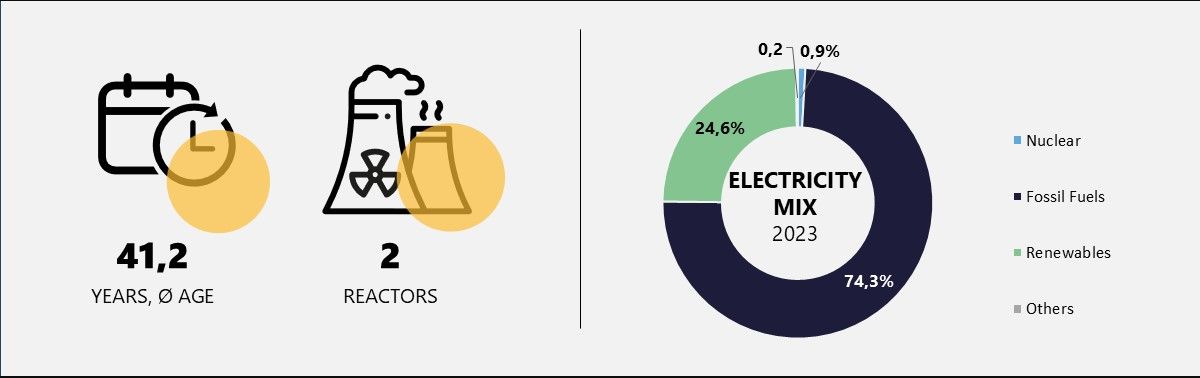
In Africa, only two reactors are in operation, accounting for 0.4 per cent of the continent’s total electricity mix. They are both located in South Africa where nuclear energy accounts for 3.3 per cent of the electricity mix. Both plants were built at the same time and were connected to the grid in 1984 and 1985 respectively, resulting in an average age of 41.2 years. According to the “Integrated Resources Plan,” which came into force in autumn 2025, an additional 5,200 MW of nuclear generating capacity is to be developed by 2039.
However, as the continent’s power grids will need to be expanded in the coming years, nuclear energy could play a greater role in the future. This also makes the continent interesting for foreign investors, with some countries (such as Ghana, Nigeria, Kenya, Rwanda, and Uganda) specifically looking at how to realise a move towards nuclear energy. Countries such as Egypt, Ghana, and South Africa are also considering SMRs.
Four Russian reactor units (VVER‑1200) are being built at the El Dabaa site in Egypt. The construction licences have been granted and work is underway, but the planned commissioning is being delayed. According to current plans, Unit 1 is now expected to enter operation in 2028 instead of 2026.